
07:30, Saturday the 1st of February 2020
Rising early and slipping out of my dorm quietly in the dark to avoid waking the soft bodies curled on bunkbeds, I met Maika outside my hostel and we set off into the city of Da Lat. The road sloped down consistently as it curved through the town, and I realised that this was the first town I had been to that had real hills. Even in the mountainous areas of Ha Giang and Sapa, the only towns are nestled safely in the flat valleys.
After eating some noodles and dumplings for breakfast, we continued into the narrow streets that form the very centre of Da Lat near to the market. The walls of these narrow lanes feature vibrant great murals of all description, from the yellow simplicity of bright flowers covering an entire house to the chiselled depiction of Dr Yeltsin, the Frenchman who first “discovered” the town of Da Lat, and other portrayals of the famous landmarks of Da Lat. Men on motorbikes gently and deftly picked their way through these narrow corridors of colour, avoiding the locals sitting on stools eating noodles or the local dish Banh Can. And amongst it all I wandered in Maika’s wake, eyes wide and curious as a toddler.
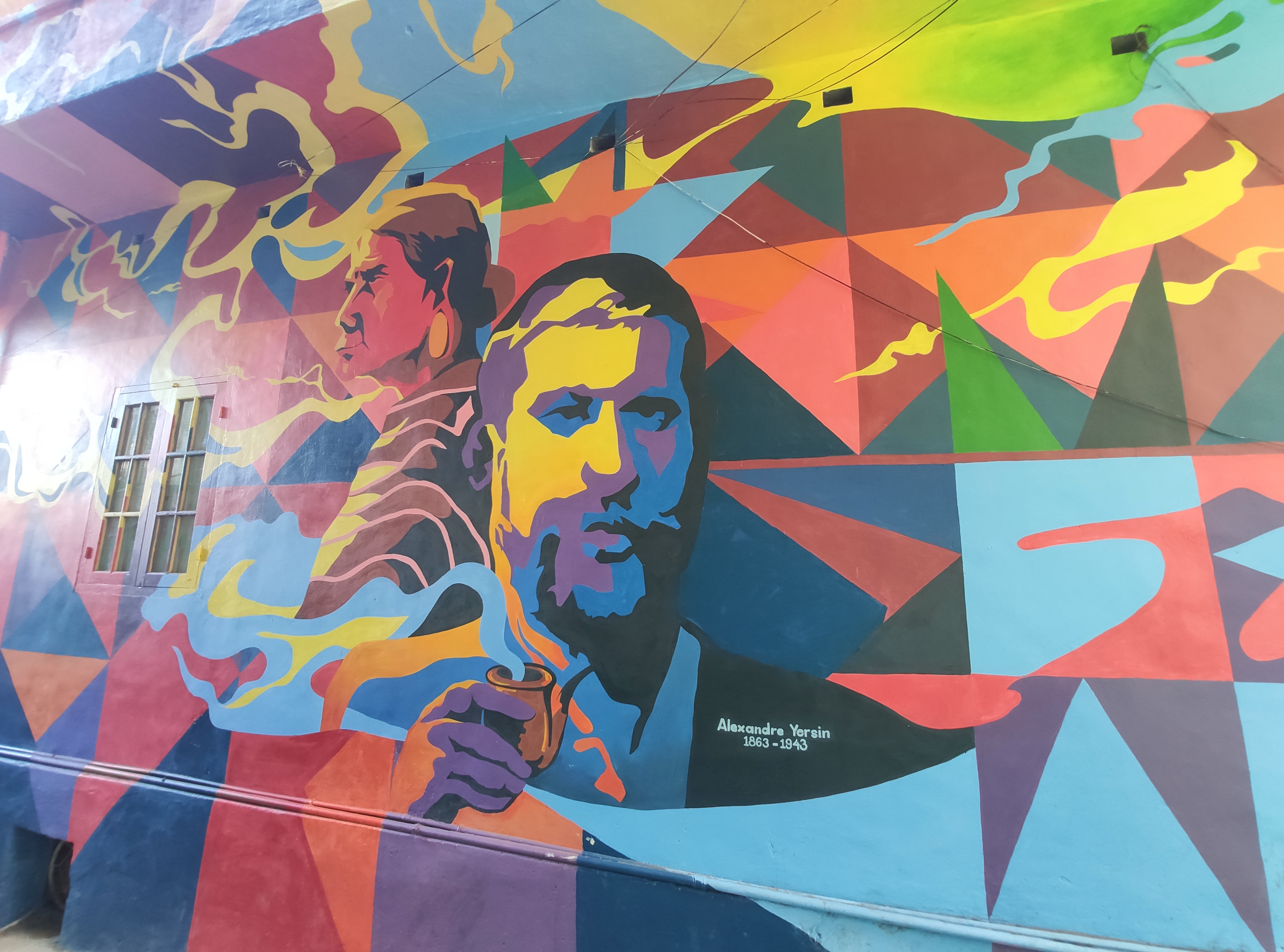
Dr Alexandre Yeltsin 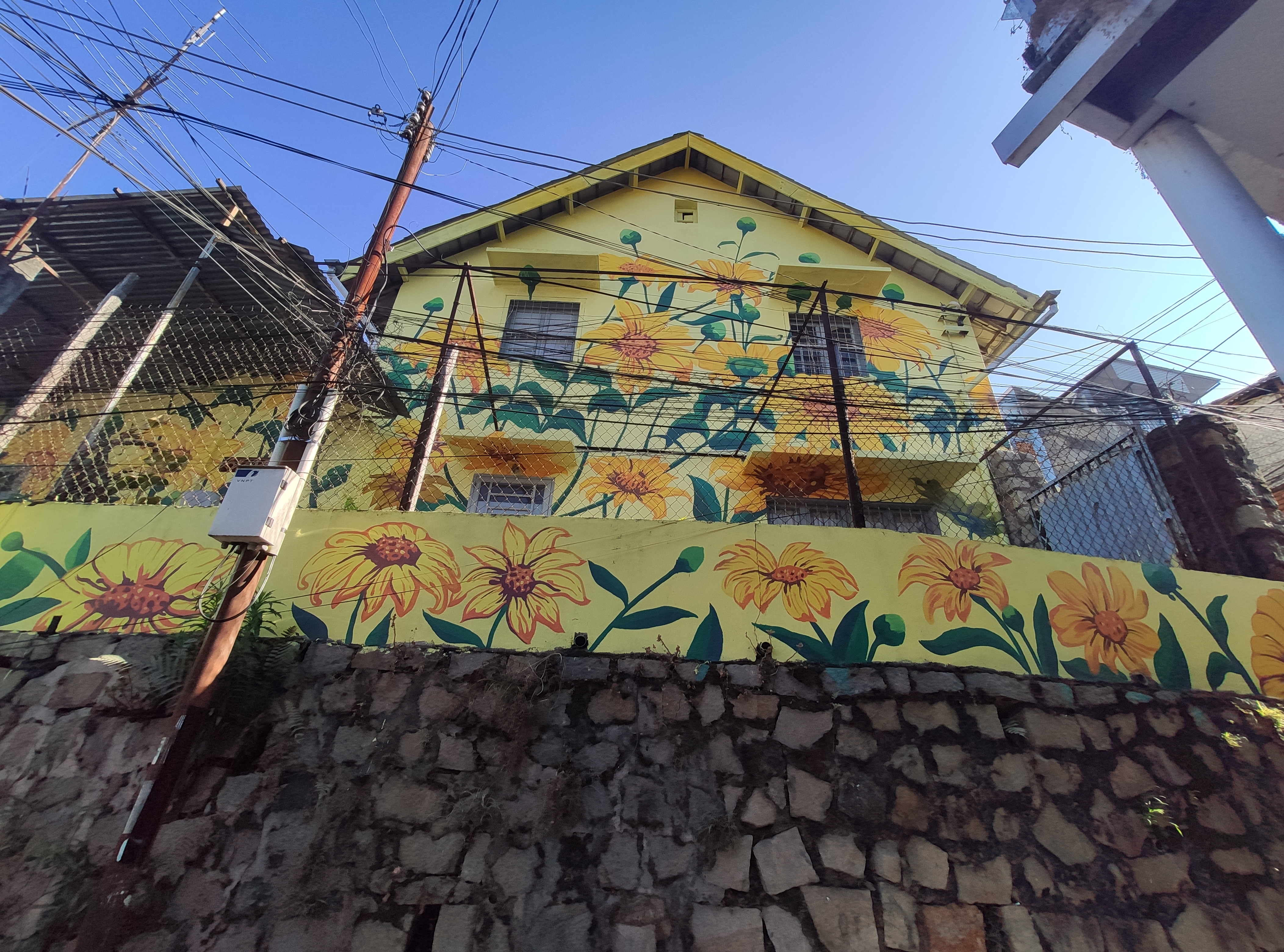


Heading downhill again towards the lake, we hired a tandem bike and set off across a busy roundabout. When I voiced my nervousness on the bustling roads, Maika replied that the whole city of Da Lat has not a single traffic light. Putting my faith in Maika’s local knowledge, I pedalled on and began to gaze around me at the buildings and features of Da Lat.
I had caught a glimpse of the bustling night market last night and the black mirror of a lake, but in the rush to check in to my hostel I had barely managed to take any details in. It was a beautiful crisp morning, air surprisingly icy cut through my lungs despite the yellow sun that warmed me from the outside. Da Lat’s reputation as the city of flowers soon became obvious. And as my friend informed me, I had just missed the annual flower festival of the previous month.
Passing a famous landmark known to the locals as the “rooster church” (a Christian church featuring a model rooster perched on top of the steeple), we continued on past a wide strip of hydrangeas on the roadside and down across another chaotic roundabout to the road that skirted the lakeside.
Flowers raised their smiling faces to beam up at the sun everywhere I looked, and we stopped by the side of the lake to take some photos as the weather was providing us with such beautiful views. The lake in Da Lat is restrained at one end by a dam which also functions as a bridge. It is curved in a lazy U-shape, and does a great deal in making the metropolitan side of Da Lat seem insignificant in comparison with its natural side. The lake is just big enough to convey a truly natural feeling, and as I looked down to one end from where we stood and saw the distant peaks of Lang Biang mountain reflected in the glassy water, I was struck with awe at the beauty of the lake. There was no wind, and only a gentle breeze disturbed the surface of the water ever so slightly. Looking directly across the lake I saw the green trees of a private golf-course, framed above by the bright blue sky, and below by its reflection in the water.


After returning the bike, we headed into the bustling market and I instantly lost all my bearings until we were guided back out and up some stairs to the food court where various restaurants sold all manner of food. Maika led us to a restaurant selling Bun Thit Nuong, noodles with barbecued meat, which I found to be utterly delicious, and which remains a favourite of the many dishes I tried in Da Lat. Exiting through the food market, the piles of artichokes and huge avocados caught my eye. Maika promised me we would try the local speciality, avocado ice-cream, at some point during my stay.

That afternoon, after returning to Maika’s house and meeting her family who welcomed me warmly, we took one of their bikes and rode out of the city to visit the clay valley. A well-known tourist destination and check-in point, we found it to be bustling with Vietnamese tourists. I considered whether this was an improvement on the countless Europeans on Cat Ba, or the Russians and Chinese in Nha Trang, and decided that tourists are tourists: equally insufferable regardless of origin.
Nevertheless, the clay valley itself proved to be fascinating and impressive. It was a testament to the most famous landmarks of Da Lat, and included a little touch of everything the city is famous for. Reproduced in the hard clay walls lay the famous train station of Da Lat, the rooster church, the lyrics of a local folk-song, a giant bell from a famous pagoda and countless other details. At the end of the valley lay an infinity pool with two giant stone heads facing one another. As Maika explained to me, these were meant to represent the twin peaks of Lang Biang mountain, the tallest mountain in the area. A folktale surrounds the mountains, with one peak representing the man, Lang, and the other the woman, Biang.


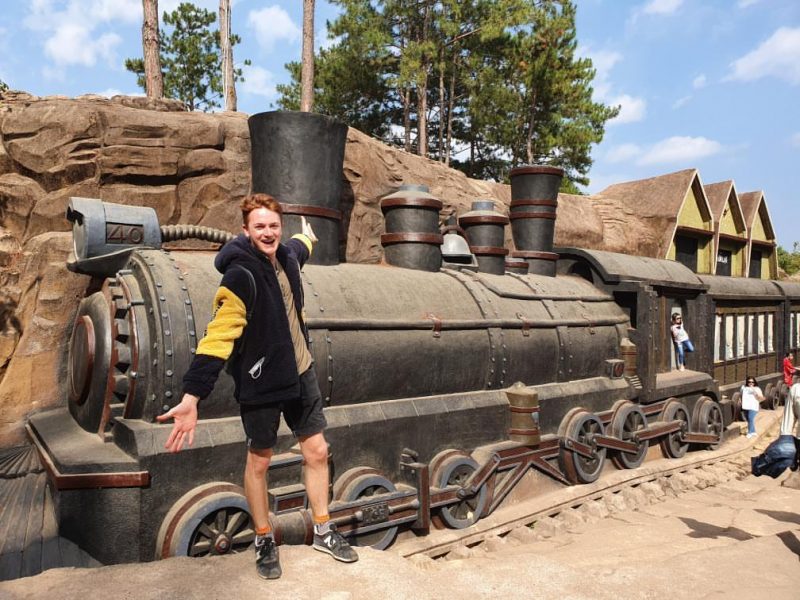

Heads representing Lang Biang
On the way back to the city, we stopped to turn up a treacherous track into a pine forest. Climbing to the top of the hill, we sat and watched the sun drift ever so slowly towards the horizon, chatting about anything and everything.


Before the sky had begun to darken, we ventured back down the slippery track. The ground was littered with slippery pine needles and roots, and our bike proved no match to one root in particular, which flung us both sprawling sideways onto the floor. Minor scrapes and bruises addressed, we continued on our way back to the city, pausing for a Banh Mi along the way.
That evening Maika took me walking around the lake to the big square that sits in front of the underground supermarket. As we neared the square, walking with the inky black lake to our right, we passed rows and rows of bikes parked along the side of the road. Weaving through the bikes, we arrived at the square and saw that it was bustling with all kinds of activity. People rushed around in the centre on rollerblades and kids spun in crazy spirals on little carts and trikes. The whole area was buzzing with activity, and along the sides sat all manner of Vietnamese entrepreneurs offering hot milk, barbecue sweet potatoes and corn or hiring out rollerblades, carts and segways. Hiring rollerblades that were painfully small, we spend a little while staggering around the square with cautious movements and plenty of falls. Many children approached me with the familiar onslaught of “Hello, where you from? What your name?”. They spun around me in circles and glided backwards with ease as I struggled on slowly.
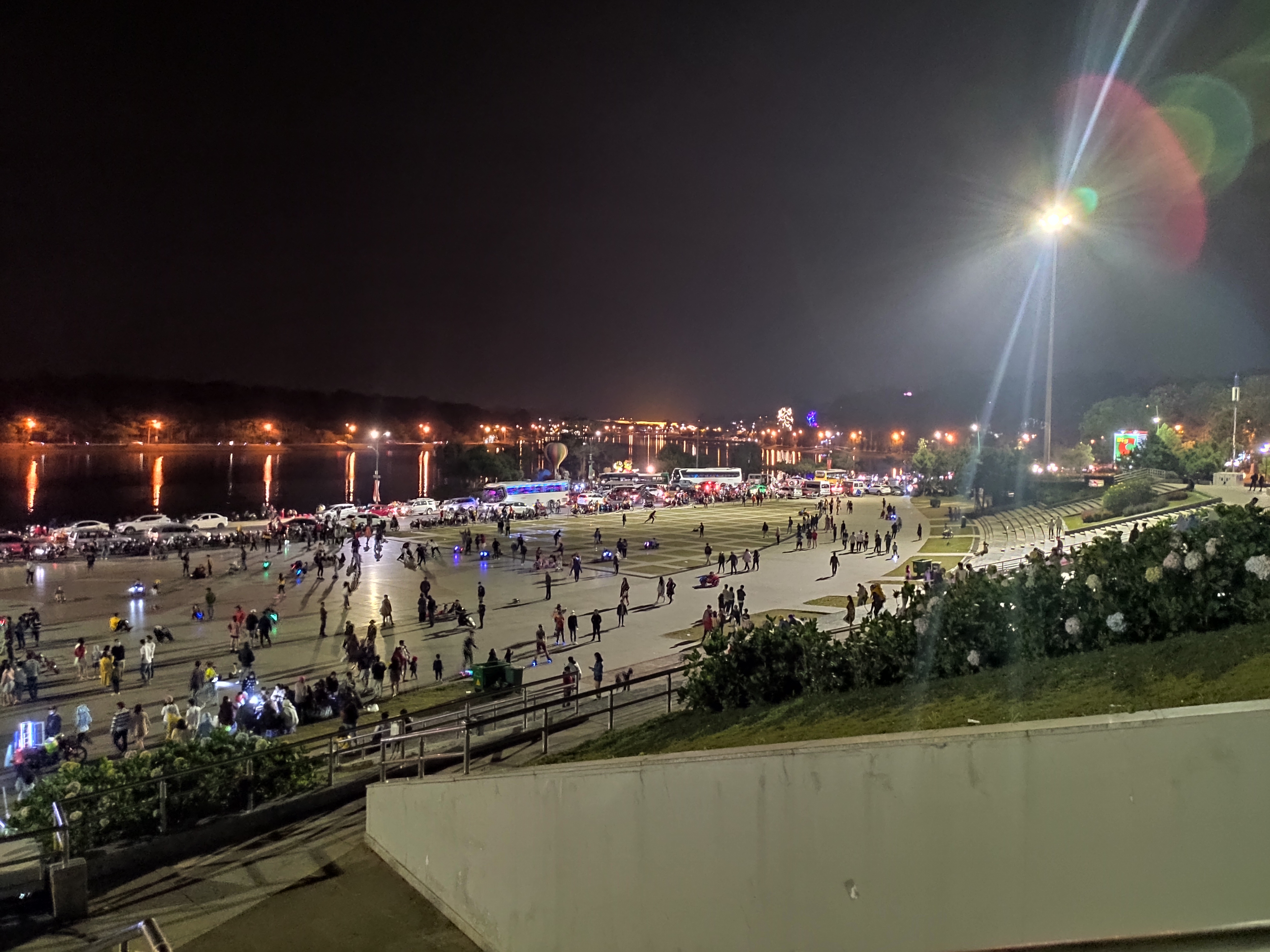
Once my big toes could take the pain no longer, we left the square headed back in the direction of my hostel. My legs were aching from all the walking we had done that day, and I flopped dog tired into bed, oblivious to the arrival of my fellow travellers in the dorm some while later that night.
2nd February 2020
The next day we ate breakfast quickly, a delicious seafood noodle dish originating from central Vietnam, and headed out of the city towards the looming shape of Lang Biang mountain.
At the foot of the mountain lay a carpark full of bright green jeeps which could be hired to make the trip up the winding road to the radar base. The radar base is located just a little way further along the same ridge of the two Lang Biang peaks, but is somewhat lower and can be accessed by road. It offers some breath-taking views for tourists willing to pay the 800k fee per jeep for a return trip up to the radar base. The alternative is the hiking route up to the highest peak of Lang Biang, which begins just to the right of the entrance to the carpark.
Maika and I set off up the rutted track, and before long were following a sign pointing us up a steep little pathway that cut through between some fields growing coffee beans. At the crest of the first small hill I turned around and grinned uncontrollably at the spectacle before me. Hundreds of greenhouses and polytunnels lay crisscrossed in semi-organisation throughout the valley. This stretched all the way back to where I could make out the urban areas of Da Lat, and the horizon’s familiar mountainous outline behind. These polytunnels are used for growing the flowers which give Da Lat its reputation, as well as strawberries, avocados and all manner of other fruit and vegetables.

“Go up” 
“Go down” 
We pressed on up a steeper and steeper incline, and soon we were deep inside the pine forest. All around us we saw signs of forest management. The tree trunks were scarred with black carbon, and here and there we would see a whole stump left blackened and charred. The result of this purposeful burning was a very clear and spacious forest. The sun had no trouble breaking through the canopy to bring beads of sweat to our brows. It was a blisteringly hot day, and we spent a good couple of hours slowly scaling through the pine forest until the surroundings began to change suddenly to a more wild and diverse jungle. Soon we were surrounded on all sides by the deepest greens, as creepers and vines hung softly from boughs hidden far above in the canopy. The temperature dropped noticeably, and we welcomed this gratefully. Looking all around me, I could barely recognise a single species of tree. I could have been anywhere in the world for all I knew. Soon we reached the last and steepest ascent which involved a series of crumbling and rickety steps cut into the mountainside and supported with wooden boards. Proceeding slowly from tiredness and carefully from fear of slipping, we finally climbed the last few steps and emerged suddenly at the peak.
The views that greeted us at the summit were far more impressive than I had imagined. The sky was so clear of clouds and the visibility so good that we could see for miles all around us, as the many valleys of the Lam Dong region lay flat before us. Turning towards the city of Da Lat, the views of the countless polytunnels were even more impressive from this height. Having climbed for over two hours to reach this height of 2,167m, I felt thrilled with achievement and excitement. Turning away from the city I saw what was in many ways the same landscape, but what was completely uninhabited. On the far side of the mountain there were no polytunnels, no coffee plantations, just mile after mile of endless jungle stretching over the hills into the distance. The elation I experienced then was similar to how I had felt on Cat Ba island in the nature reserve. The sheer size of the landscape was quite incomprehensible.


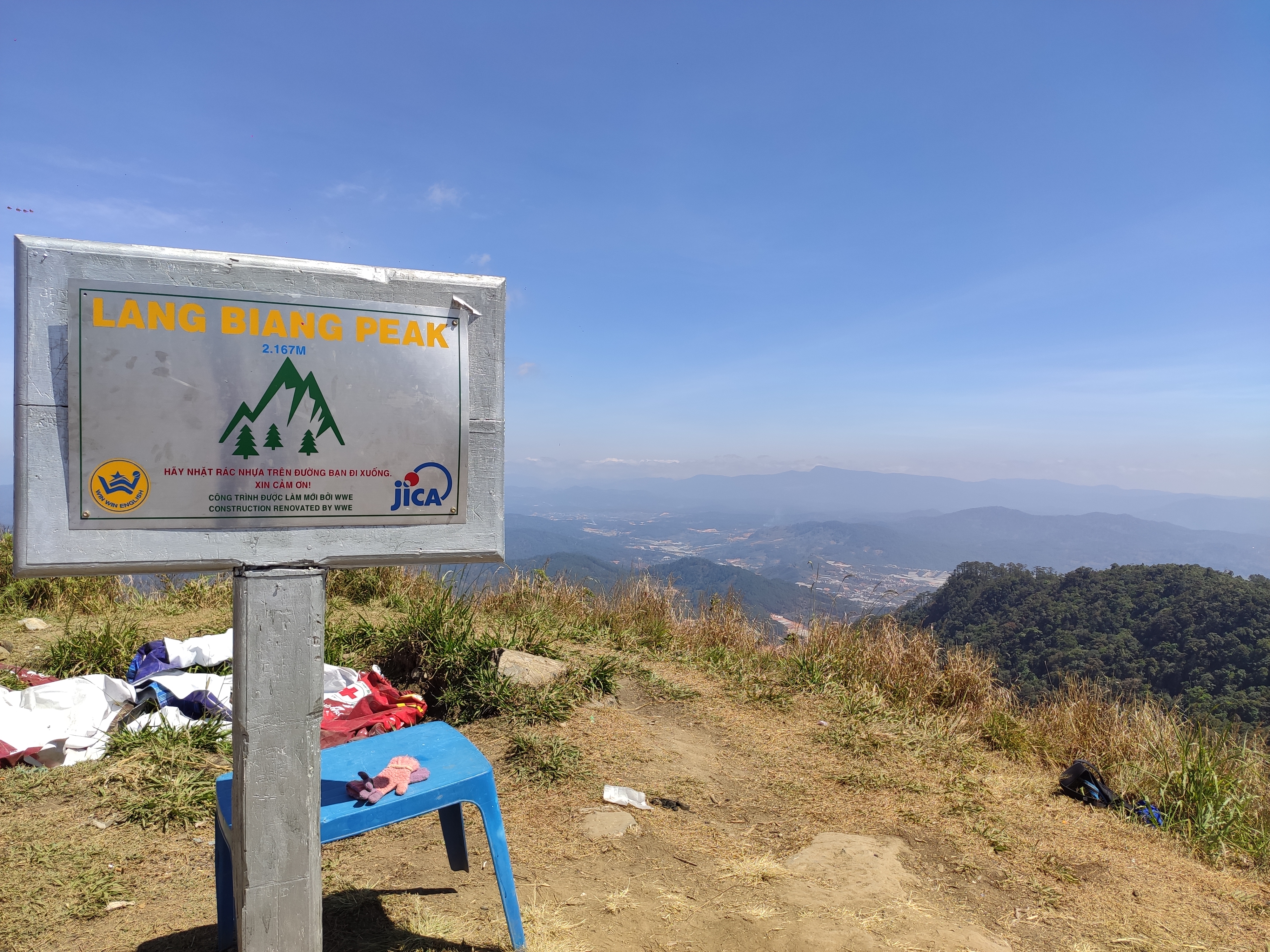

Towards Da Lat 

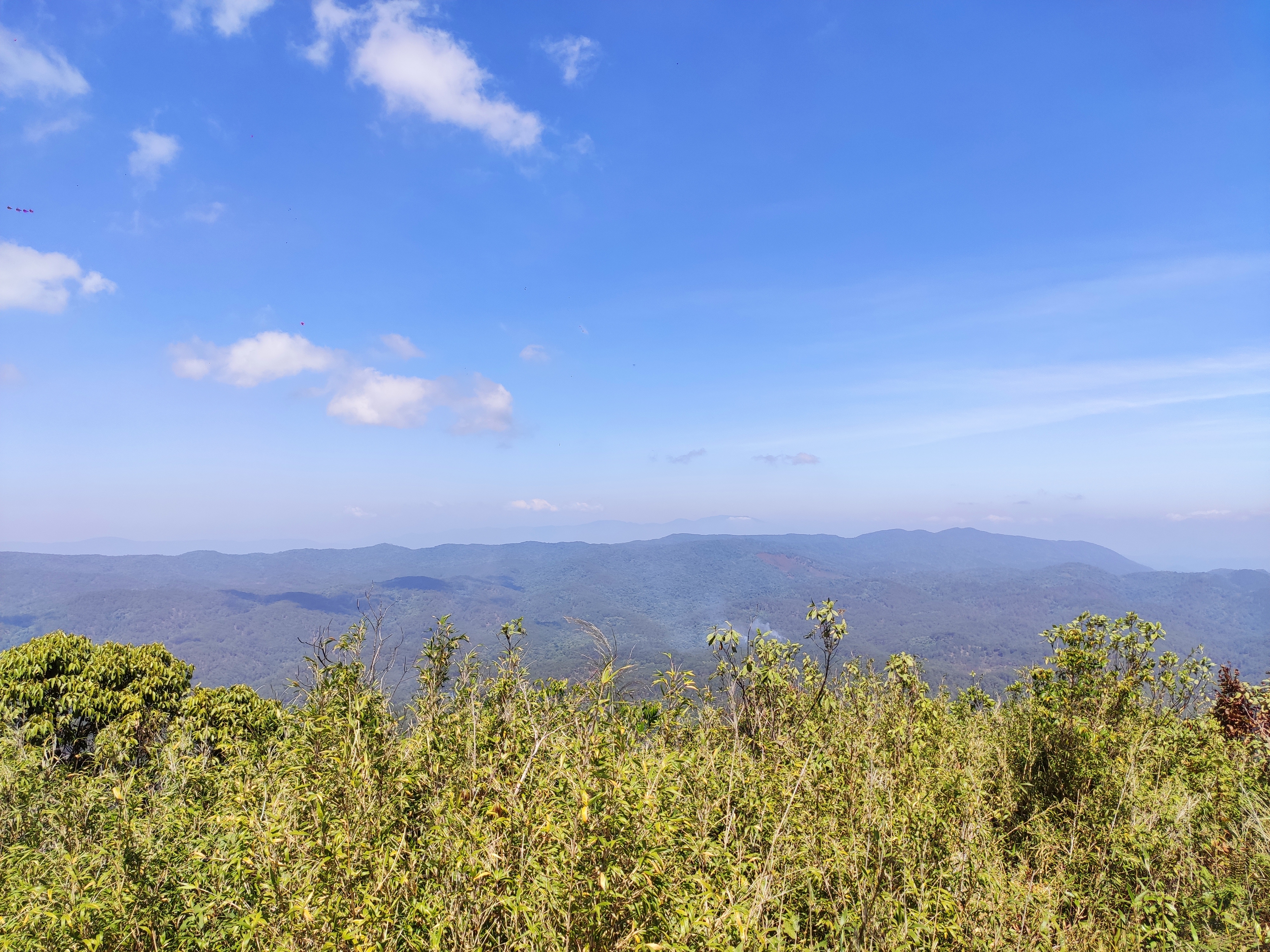
Away from Da Lat
After soaking in the view and rehydrating, we set off back down into the jungle.
The steep steps put our knees to the test as we stumbled down much faster than we had ascended. Despite our tiredness we pressed on and followed signs which took us back by a different route over the second peak. Some kilometres later we emerged, disorientated at the side of a road. This was the road to the radar base, and we decided to hitch a lift with one of the jeeps, being at the time unaware of the 800k charge. Shocked when we discovered the price, we promptly hopped out of the back of the jeep and began the descent to the carpark. By this point we were back in the pine forest, and the needles were so slippery that we were forced to proceed with great care down the steep slopes for fear of falling.
Finally, we arrived at the carpark, walking past the lines of green jeeps, the restaurant and the souvenir stalls to find our bike. Including the detour to the radar base, our hike had taken us around five hours, and we were tired and ravenous.
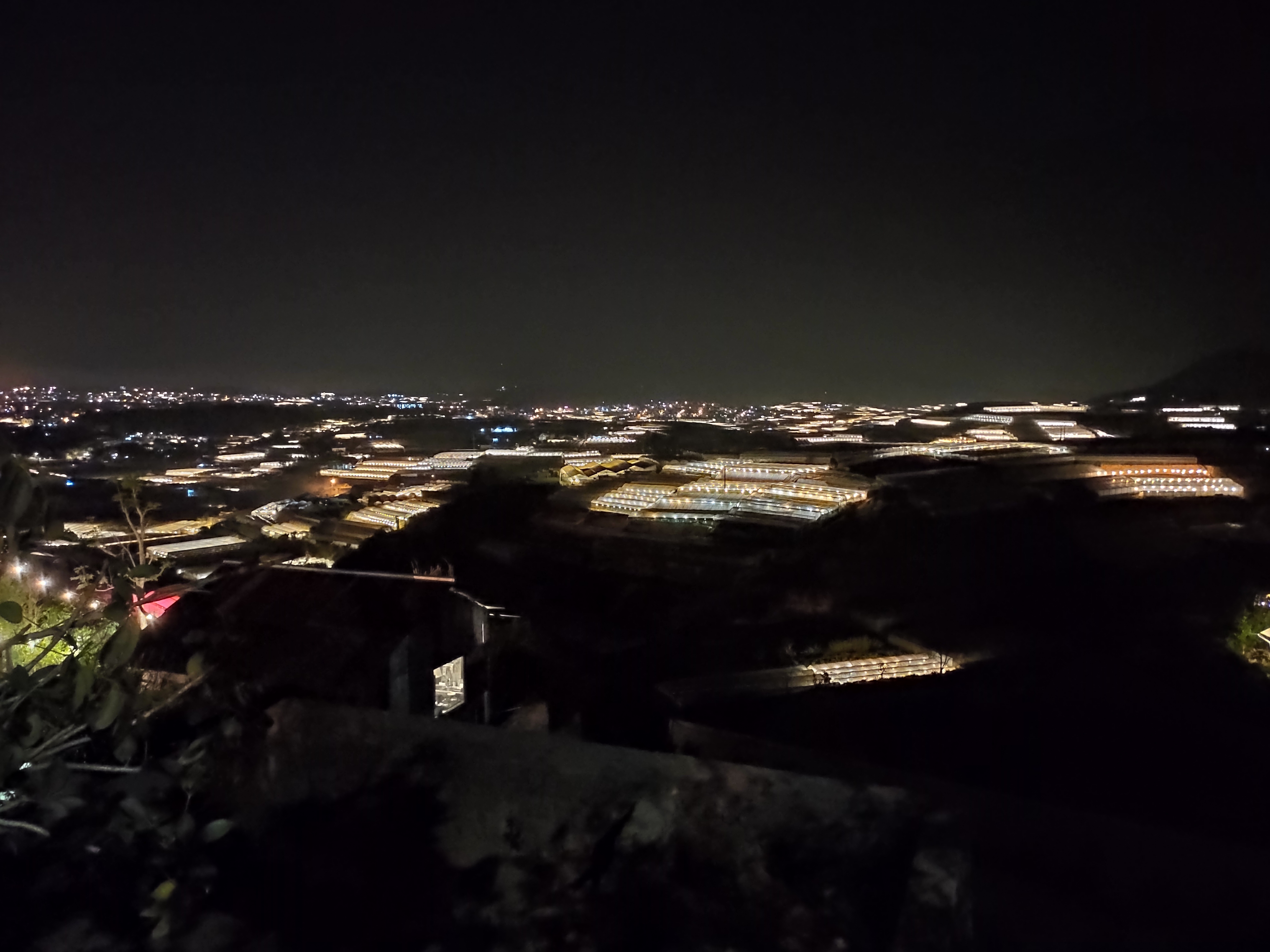
Heading back to town we grabbed some delicious banh cuon in the Da Lat style, and decided to have a restful afternoon. We visited a beautiful a café in a hostel where six dogs lazed around sleeping and occasionally fighting with each other before curling up again under a table. When it got dark, we rode a little way out of town to a viewpoint from which we could see the polytunnels in the valley below us all lit up. The lines of lights looked magical in the soft evening air. Treating ourselves to cocktails in a small bar in town, we soon headed to bed. Having walked over 25km both that day and the previous day, I fell into a deep sleep the instant my head touched the pillow.
3rd February 2020
This was my last full day in Da Lat, and despite out aching limbs we rose early again and spent the morning visiting a Pagoda on the outskirts of the city. The beauty of the architecture was unique, as all along the walls and pillar were embedded small pieces of china forming a mosaic over the entire building. Walking through an interpretation of what the eighteen levels of hell are like in Buddhism, we exited again, and, taking one last look up at a giant statue of Buddha made entirely out of flowers, we left.


That afternoon Maika was busy teaching English online, but suggested for me to head out of town to a high-wire course. After a delicious lunch cooked by Maika’s family, they kindly leant me a motorbike and I rode to the course and was soon strapped into a harness and swinging through the trees.
The courses became more and more difficult, and several times zip lines took me back and forth across the valley. The weather was as beautiful as ever, and the views from the zip lines only added to my already assured love of the Da Lat aesthetic.


After a bowl of Bun Bo that evening, I met some friendly Canadians playing pool in the bar at my hostel who overwhelmed me with their energy and the rapidity with which they switched between French and English, laughing and joking together. They were two couples in their early twenties, and their enthusiasm and happiness was indefatigable. When they invited me out to a bar with them, I needed no persuading. The bar we went to was utterly unique, being called ‘The Maze Bar’ for very good reason. Inside was a crazy maze which must have taken up the whole seven storey building. It was filled with tiny little alleyways and hidden staircases and in my tipsy state I dreaded to think how difficult it would be to navigate when properly drunk.
We laughed together and played drinking games and then the bar was closing, and we were back in the hostel and before I knew it my 6am alarm was waking me up.
For breakfast on my final morning Maika took me to eat Banh Can, little cakes made from rice flour with an egg in the middle, dipped in sauce. This was utterly delicious, and I was mesmerised watching the lady cooking. She had a large round hotplate in which were indented a dozen or so little hollows roughly the size of a tennis ball. Into these little bowls she periodically poured a small spoonful of batter to create the little cakes which tasted not unlike savoury pancakes.
I was glad to have ticked this local dish off my list, and as Maika drove me to where the shuttle bus left for the airport, I felt pleased that my stay in Da Lat had been so full of new experiences. I bid a sorrowful farewell to Maika, thanking her for all her kindness, and that was that. I was back on the road.
Da Lat airport is one of the smallest airports I have ever visited, possibly only trumped by Exeter airport. The check-in was smooth, and we were soon barrelling down the runway and lifting off up towards the blazing hot sun.
The view of the landscape below me was incredible, the clear weather giving me a perfect view of the mountains, the villages and all the little fields and rice paddies. From a bird’s eye view the agricultural land of Vietnam is entirely different to that of England. Each field is tiny, and they curve and merge together utilising few straight lines. I was struck by how different it looked to the familiar patchwork fields of England. The difference between large commercial farms and small-scale subsistence farming is obvious when seen from above.

I sat back and music carried me along northwards as clouds began to form beneath us. Da Lat had been a whirlwind of activity, and I was happy that we had made the most of every hour spent in the beautiful city.
An hour later, weary and satisfied, I touched down in the North.
 The Bus to Nha Trang – Vietnam Blog 8