
31/05/2019
Having awoken to the sound of a piercing cacophony of birdsong with its discordant harmony of traffic on the nearby road, I began to slowly pack up my things and was soon on the road. I had camped the previous night in the middle of farmland and was lucky to find a small wooded copse with a small clearing which would provide me with shelter from the wind as well as prying eyes.
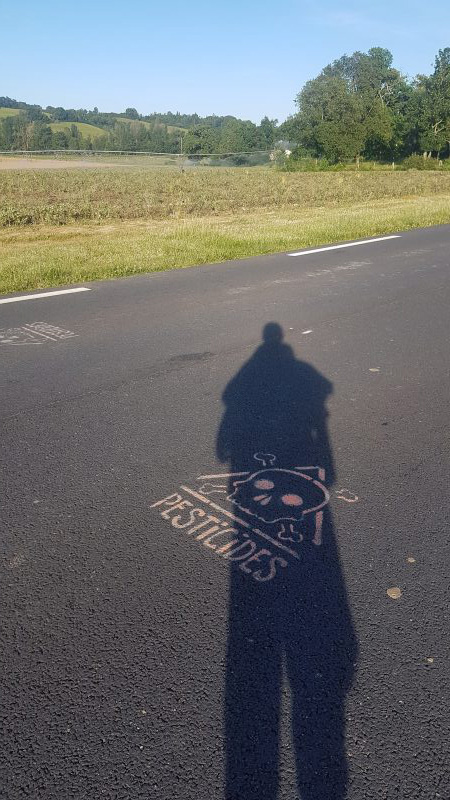
I began to walk along the road to Foix, still around 30km north of the town, holding my thumb out whenever any vehicle passed me. As I continued through the somewhat bland landscape of empty fields mixed with fresh wheat and grasses, I saw numerous skeletal features set out across the fields. I soon realised these were irrigation systems, and as I neared a little hut on the side of the road, whose purpose remains unknown, I saw it had “pesticides” stencilled all over the walls, with a skull and crossbones symbol.
Before I could spend too long thinking about the farming methods in these areas, a man in a small Citroen picked me up and said he could take me all the way to Foix. He spoke good English and was cheerful and laughed often. I came to enjoy his company as we drove on for almost half an hour. He told me how I was very lucky to find the weather so pleasant, and also how lucky I was to be given a lift as in his words “the people here are very boring. Lots of farmers. Don’t like foreigners.”
Foix was a busting metropolis in comparison to the tranquillity of the softly spraying irrigation systems in the fields to the north. It was market day, and I smiled to myself at how lucky I was to have made it this far early enough to witness the market. It was a traditionally French setting, with fruit and vegetables alongside fine cheeses and breads. In different sections of the market one could find different goods: street food was kept under a large structure like a glorified bandstand, groceries were to be found near a grand religious building of which I did not catch the name, and in the middle of town inside an elongated roundabout was everything else. Clothes, literature, music, accessories and all kinds of junk provided a feast for my eyes as I wandered through it all.
For lunch, I sat in the Jardins Publiques, and ate a fresh baguette, some cheese from the market and drank a French beer which was very strong and not altogether good. The garden had a lovely atmosphere with lots of children, and later two men with a clarinet and an accordion came to play and sing for us all.
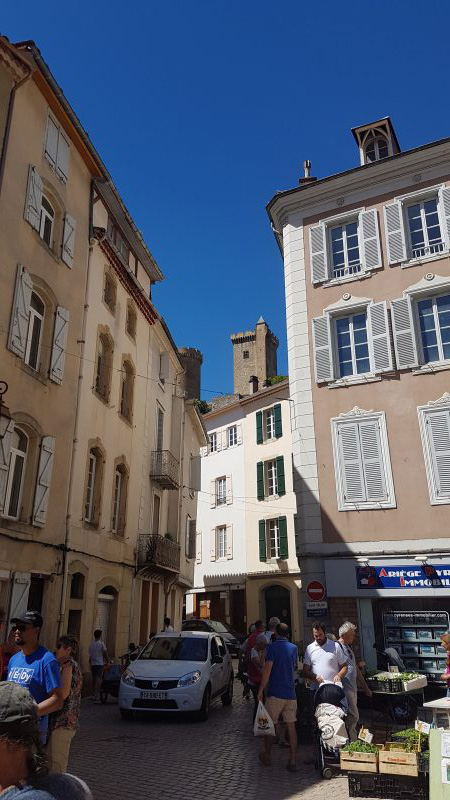
Foix is a traditional town and the architecture is what shows this the most. I was awed by the castle and immensely disappointed when, walking all the way around it, I found the only entrance seemed to be closed for maintenance. However, I still managed to observe from a distance and admire the architecture not only of the castle, but of the tall houses with their shuttered windows which were crammed into tiny winding streets in the centre of town.
On leaving Foix I was nearly instantly picked up by two men in a Mercedes whom I discovered were Romanian and both spoke perfect English. Indeed, when they rolled down the window and I asked “Ou allez vous?” their simple answer was, “Do you speak a bit of English?” These two men provided me with one of my most rewarding trips. Stan was the passenger. He had round black glasses and a bushy beard, a smoking habit and, as I later learned, lives in Denmark. Alex, the driver, dubbed by Alex as a “speed demon”, lives in Switzerland and works for a multinational corporation. The two friends were very talkative, and we immediately began discussing how it was that both of them came to live outside of Romania. I learned a great deal during this journey, of how in Romania it is almost impossible to rise to the top, and one may work incredibly hard and still not raise enough to support a holiday. We began to talk about the failings of the system, and how, during the European elections, Stan was forced to wait for 9 hours in the queue to vote. He explained his opinion of how it is simply the footprint of the USSR on Romania, and that the leaders of the country are still incredibly corrupt and will make it as hard as possible for the people to vote against them.
We spoke of many different things: Europe, the European union, Brexit, globalisation, communism, working life and people’s prejudices and unfounded beliefs. It was a most fruitful journey, and I was sad when it finally came to the point in the road where they turned off right to head to Andorra.
Waiting again at the side of the road, I witnessed three border patrol officers methodically stopping cars and speaking to people as they headed north into France. Then, a large herd of cows came past along the road, causing a traffic jam that lasted for the next twenty minutes until I was picked up by a learner driver and her mother, who said they would take me to Porté-Puymorens.
It was from here that my journey into the mountains began.
The GR10 path winds up the valley from Porté-Puymorens and gradually increases in altitude. Starting near the road at 1681m climbs around 600m in 10km, and ends up at Barrange Lanoux, an EDF damn used for hydroelectric purposes. The path was rugged and harsh, being comprised mainly of skree that had been slightly compacted by passing hikers. In the first hour or so I passed a few different walkers on the way down, and a man wearing a Toulouse Marathon shirt overtook me on the path. Not long after the halfway point, I began to struggle. It was clearly just a mental struggle, and deep down I knew this. I had not seen a living soul for 45minutes and had just rounded a large corner in the valley which put me in the shade of the sheer rockface above me. To my right was always a drop of a few hundred metres, and the tricky terrain meant I had to watch every step. Something about being alone, how awestruck I was by the sheer size of the mountains, and tiny little path and the knowledge that I still had around a thousand metres to climb before I would be at the summit of Pic Carlit made me feel as if the task at hand was simply impossible. The man in the marathon shirt, having presumably reached the damn and turned back, passed me shortly, leaving me as I assumed, completely alone.
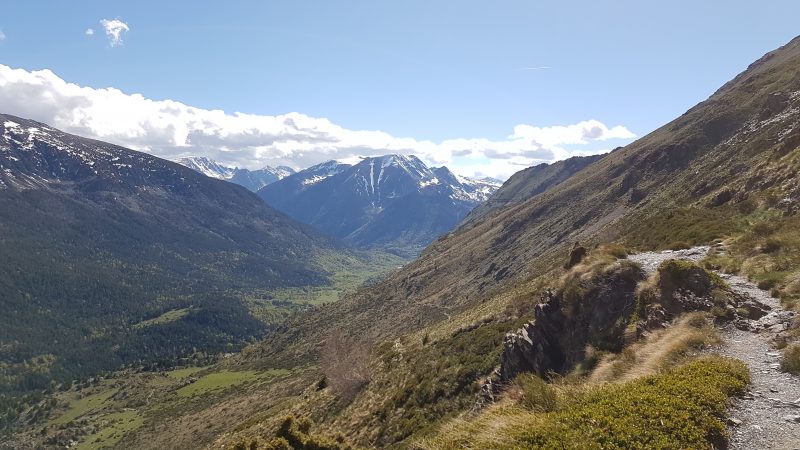
At this point I simply had to focus on the physical, as the route itself was not too long and despite my backpack of around 16kg, I had the strength left in me to do it easily. I knuckled down and finally made it to a small bridge below the damn, crossing the small stream which originated from the reservoir’s discharge. To my surprise, as I crossed this bridge, a bouncy white dog came running up to me which looked like a springer spaniel, and shortly afterwards I laid eyes on its owners, a French couple toting binoculars and fishing rods, heading up the path to the damn. With neither party being able to speak the other’s language, we stumbled along to an understanding and the women pointed in the direction that I was to go.
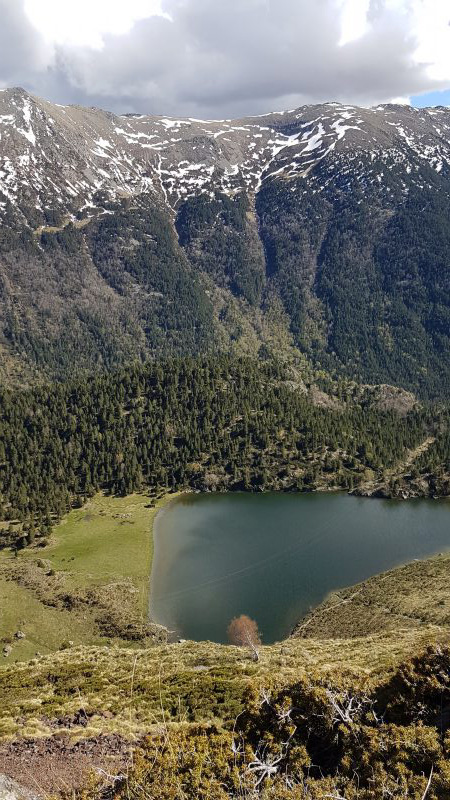
Refuge des Ingenieurs. It is where I am now. It is a rather large, brick walled refuge with a private area taking up most of the space and a free, public space at the end sleeping 12 people on bunkbeds. Whilst the public area is not at all glamorous, it is far better than a tent, and cooking outside in the evening next to a fire was very enjoyable. There are several people staying in the private area, including a family with four children, and this made me feel far more confident about everything. With some good food inside me, I headed to bed for some well needed rest.
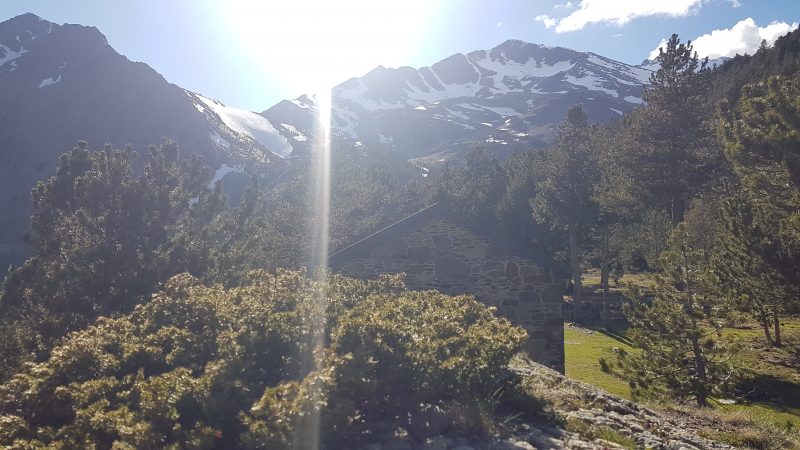
Tomorrow I plan to climb Pic Carlit.
Til next time,
Stay Hydrated
 France 2019 II – Toulouse