
Chu, 22nd of January, 3 days until the Lunar New Year.
The instant I stepped down from the bus, smacking my head on the roof as I alighted, I noticed two things. First was the reassuring familiarity of the main street in Chu. Across the street lay the bakery I had come to frequent. To my right the bright yellow post office (which I was too scared to set foot in, having accidentally paid far too much for express delivery of letters to England the previous month). And ahead of me, just past the Xoi stand, sat the smiling shoemaker who had made it a habit to wave and invite me to sit with him every time I came to buy sticky rice for breakfast.
But the second thing that I noticed was an unmistakeable air of festivity in the town. It was not merely the vast array of flowers laid out for sale in front of the post office. Nor was it merely the bunting strung across the street as far as the eye could see. Nor was it merely the familiar red national flags with their proud yellow star that hung outside almost every shop, accompanied more often than not by red lanterns and other decorations. No, the festivity was felt most genuinely through the people. The smile from the shoemaker as I walked past felt warmer than usual, as if it had an added dimension of seasonal sociability. And as I walked back to Sun School through the market, the waves and smiles of the traders all came with an undeniable atmosphere of merriness and excitement. The old ladies selling noodles hollered at me in their usual way, one of them rushing up to me and grabbing my arm, her rapid onslaught of speech proving entirely too much for my primitive vocabulary. Smiling bashfully and detaching myself from her grasp, I wished her a happy new year and continued on past rows and rows of cumquat trees which lined the street for hundreds of metres.
Several hundred cumquat trees later, along with a few hundred peach blossom trees for good measure, I arrived at sun school.
Inhaling deeply as I stepped through the door, my lungs were filled with the harsh chemical tang of cleaning product. I proceeded upstairs to find Ha and Thai, equipped with mops, cloths, buckets and soapy water, waging a war on dirt to the tune of bolero music blaring from the office. This then, was the first tradition of the Tet Holiday.
The Vietnamese do not celebrate Christmas in the same way as western countries, nor do they celebrate new years eve on the 31st of December. Indeed, on Christmas day 2019, I held lessons in the evening just as any other day that week. Instead, the Vietnamese celebrate the Lunar New Year, often known in the west as the Chinese New Year. Like Christmas in England, there are many traditions surrounding this holiday, and most schools have a holiday for 1-2 weeks. Staying with my lovely host family in Chu, I was fortunate enough to be able to witness first-hand how a typical family celebrates the Tet Holiday.
Ha explained to me that the Vietnamese believe it is very important that you start the year as you mean to go on, and that having a clean house for the start of the new year would bring you good fortune later on. Without hesitation I rolled up my sleeves and got to work cleaning and tidying my room and the bathroom on our floor. By the end of the day, the house was fresh and sparkling and I began to understand how this tradition, somewhat like spring-cleaning in England, is a very positive way to start the new year.

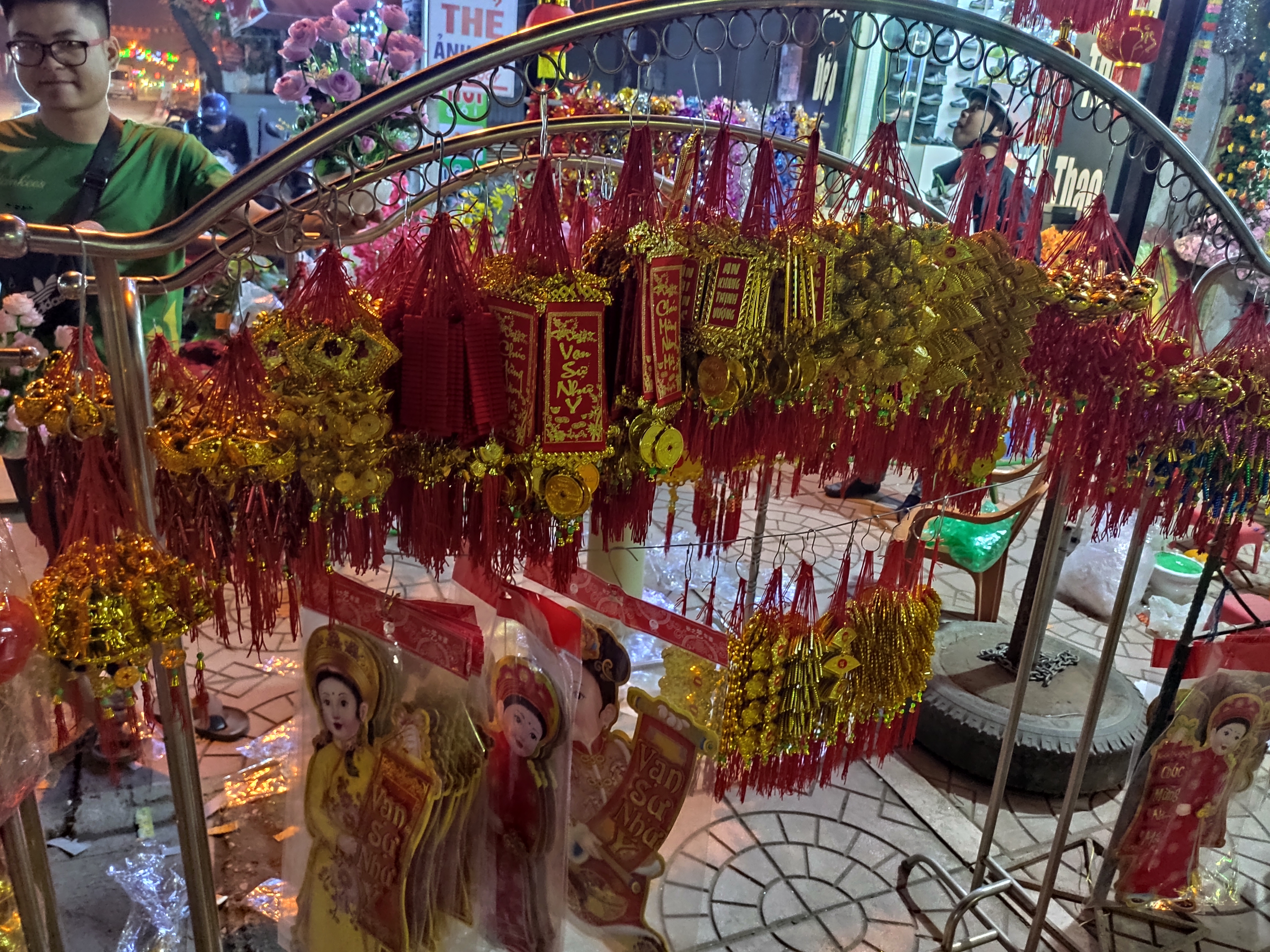
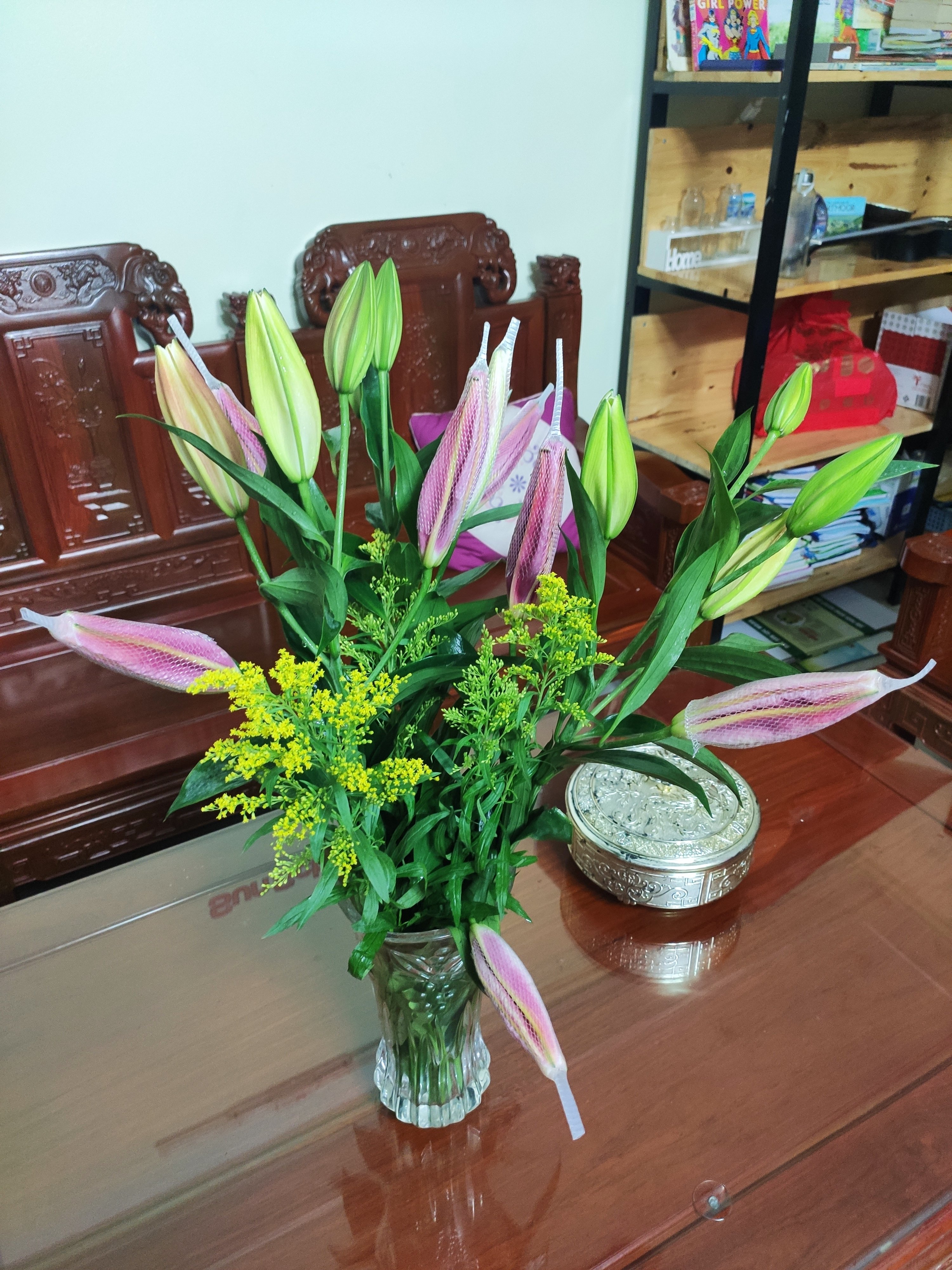

Later that evening, we went out with the family to buy flowers, decorations, and our very own cumquat tree. I felt certain there must be some reason behind the use of cumquat trees and peach blossom for the Tet holiday. But on reflection, I myself cannot explain the reasoning behind our buying and decorating of Christmas trees in the west. The two traditions have obvious parallels. The trees can be seen for sale lining the streets all over the town, and each family invests in a cumquat tree, a peach blossom, or both. We transplanted the tree into a pot and set it proudly in the office, adding small red decorations as finishing touches to the festive ornament.

23rd January 2020
The next day I was introduced to what is still my favourite tradition of Tet holiday, albeit quirky in the extreme. Ha took me to the market in the morning to buy ingredients for our midday feast, as well as three other special purchases. We walked home after a successful trip, arms laden with fruit and veg, and in my left hand, carefully sealed inside a plastic bag filled with water, swam three little goldfish.
Gently depositing the fish into a bowl of water and placing them delicately on the table in the prayer room at the top of the house, we began to cook lunch. Once cooked, we climbed the several flights of stairs to the prayer room at the top of the house and laid the food on the table. Waiting until the strike of noon, Ha then said a quick prayer and explained that we would now wait fifteen minutes.
She explained to me that the three fish transport the gods of the household, in particular, the kitchen god, back to heaven. Once in heaven, they report to the jade emperor of all that has happened in the house over the past year.
After the fifteen minutes had elapsed, we carefully carried the fish downstairs and rode the bikes through town and down to the edge of the river. Ha knelt by the water’s edge and ceremonially released the fish into the river, and thus the household spirits were set free and transported back to heaven to report on the past year at Sun School.
Having grown up atheist surrounded by a society which blindly accepts the traditions of Christianity without true faith in the religion, I was fascinated by this entirely new and different tradition.
After releasing the fish into the river, we returned to Sun School and feasted on the meal I had assisted Ha in preparing.
24th January, New Year’s Eve 2020 (Lunar Calendar)
The next tradition Tet had to offer me was waiting at the door early in the morning in the shape of a hoe and small scythe. Thai drove me us through the town as I clung desperately to the tools, determined not fulfil the images of 21st century jousting on motorbikes that played out in my imagination. Arriving at our first destination, thankfully with zero casualties, we approached two tombs sitting beside each other in the peaceful corner of a field of oranges.
Nature had been hard at work all year round and the result was that the tombs were entirely covered by tall grasses and weeds which sprouted from cracks, reaching up desperately for sunlight, seemingly undeterred by any laws of physics.
We got to work, and soon our brows were sweating in the hazy morning sunlight and our hands were dirty and scratched from pulling at the infuriatingly stubborn roots of the weeds. I learnt from Thai that these were the graves of his grandparents. And that it was tradition to clean the tombs before every Tet holiday. We communicated with sign language, English and Vietnamese, and managed to understand each other with as few as five words each.
When the tombs were finally clear of weeds, Thai lit incense sticks and placed them on top of each tomb, offering a quietly whispered prayer, before gesturing me to follow him onwards.
We repeated the same process, clearing weeds and lighting incense at two more tombs in separate locations. I learnt later that these were the tombs of his great grandparents. All the while we worked on the tombs, the peace and quiet of the fields of orange and pomelo trees was punctuated regularly by colossal explosions from fireworks both nearby and far off in the distance.
If they were already sending rockets high into the bright sky at ten in the morning, what kind of spectacle would I see before me at midnight? Ever since arriving in Vietnam I had noted almost every day, sometimes in the evening, sometimes in the morning, that loud bangs could be heard all throughout the town. I was excited for the display which awaited us that evening.
Despite the fact that it was quite literally raining on our parade, Sosanna and I nevertheless walked to the square, equipped with cameras and umbrellas, to watch the fireworks display. The square was deserted as the rain continued to pour, raindrops bouncing off the floor with such ferocity that my trouser legs were soon soaked despite the umbrella. All around the square, huddled under parasols in the little popup cafes, the locals of Chu watched and patiently waited for the arrival of the new year.
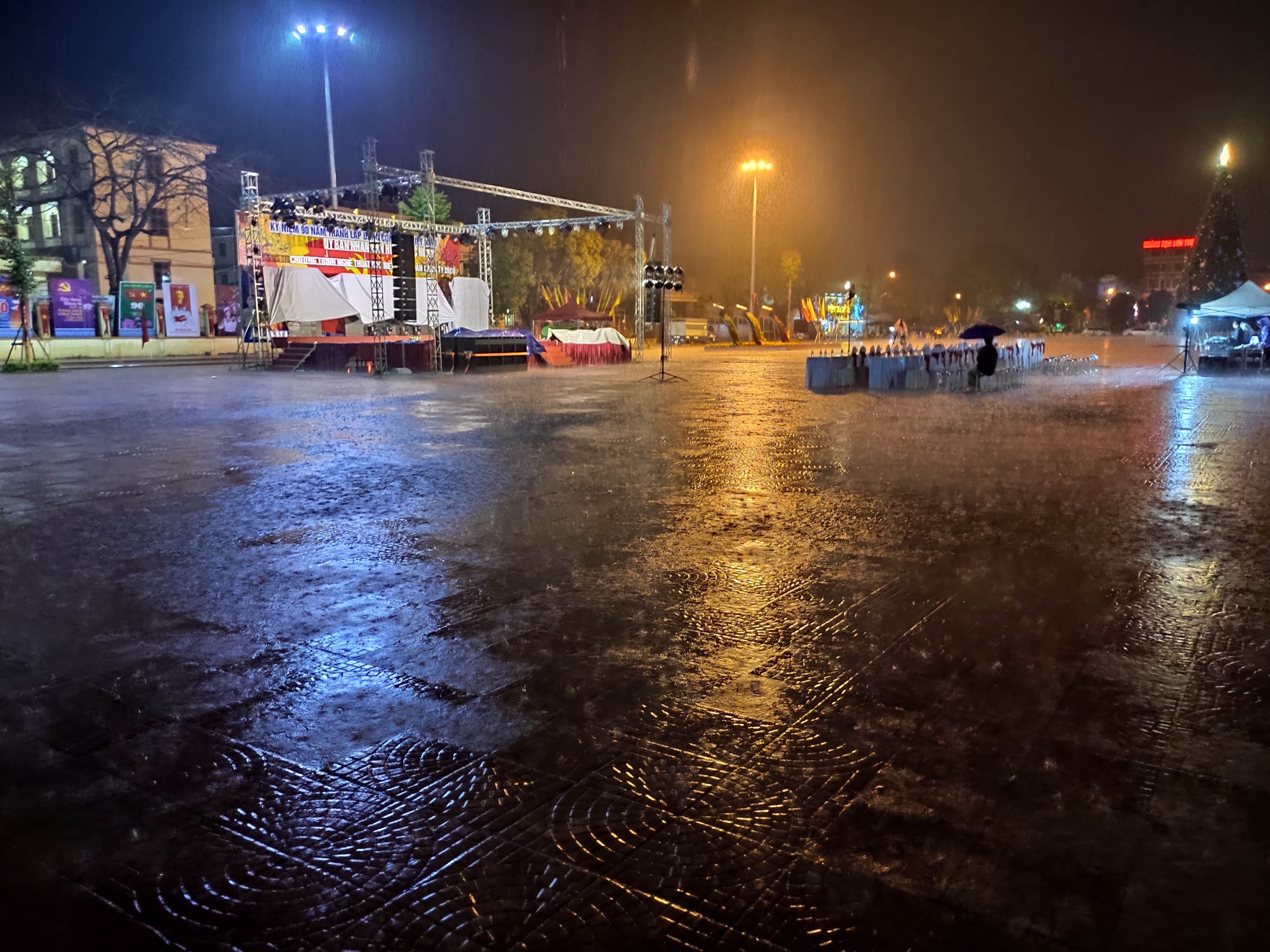
A stage had been erected in the square, and music played loudly from speakers wrapped in tarpaulins. As it neared midnight, a man controlling the music from a rickety gazebo took hold of a microphone and began the countdown. A local rushed over next to me to shelter under my umbrella, and together we chanted loudly for the final ten seconds of 2019.
On the stroke of midnight, the fireworks began, and they did not stop for a good twenty minutes or so. The feeling of elation they brought with them lasted until long after they ended, and as Sosanna and I walked back towards Sun School, dripping wet and happy, we cried out Chuc Mung Nam Moi! in response to the revellers who passed us on bikes. Everywhere along the streets were happy faces wishing us good luck for the new year, and although the official fireworks were over, people continued to set off their own displays without restraint. I watched as in the distance a figure ran out into the middle of the road, dropped a small box on the ground, and ran off into the darkness. Seconds later the box exploded with a hundred tiny rockets shooting skywards with fizzes and sparks.
The ecstasy we had felt watching the fireworks calmed to a soothing positivity as we arrived back at Sun School. Ha and Thai were waiting for us, having watched the fireworks from the roof, and together we shared a toast to the new year.
25th January / 1st January (you choose)
The first day of the new year was a flurry of visits to family and friends and pagodas. First, we all rose early and dressed in smart clothes. Having brought no formalwear from England, I felt underdressed next to Thai in his crisp blue blazer and Ha and Sosanna in their traditional Ao Dai. Nevertheless, the six of us left Sun School, and headed to Ha’s parents’ house where we took photos in front of their Hoa Dau (peach blossom tree).


We exchanged good wishes for the new year, drank small cups of tea, and the adults gave the children Li Xi. Li Xi (lucky money) is a curious tradition which involves adults giving money to children during the Tet season. It can be anything from 10k to 100k, depending on how generous you’re feeling or how well you know the child. I myself was pleasantly surprised to receive lucky money from not just Ha and Thai, but also several random strangers over the course of the next week. My understanding of the tradition is that the Vietnamese believe that the first few days of the new year are incredibly important in setting a precedent for the rest of the year will go. In this time, they all practice generosity and good morals, in the hope that these good traits will stay with them for the rest of the year. Think of it as investing in some good karma that you will be able to cash out later in the year.
As soon as the photoshoot was over, we hurried along to Thai’s parents’ house for a similar procedure. The Vietnamese believe that the people you meet in the first few days of the new year will play a big role in your life for the coming year.
And so we spent the day riding around the town visiting the closest family members and friends of Ha and Thai: the people they hope to play a role in their lives in 2020. At each house we were welcomed with smiles and handshakes and sat at the table eating snacks and drinking tea. It was an eye-opening experience, this glimpse into the lives of many different local families. Overall, I lost count of how many families we visited.
The day left me feeling impressed by the immense sense of community in Chu. I recalled how, before I left for Ha Giang, Thai had led Sosanna and I out into the extremities of Chu to the more rural areas where we visited an impoverished family living in a small structure of concrete and corrugated iron. Thai had spent the whole morning visiting such families, and this was but the last of several such trips. Each year, Ha and Thai send bags of gifts along with money to poorer families in their community. Overall the give several million dong away. For a family with limited means, this act of charity was extremely humbling and heart-warming.

The final experience of the Tet holiday which I would like to share involves the visits to several pagodas in and around Chu. I am unfamiliar with all the deities in Buddhism, and as there are many different strands of Buddhism it was difficult for me to follow the purpose of each pagoda. Ha practices Zen Buddhism, with an emphasis on mindfulness and a reverence for Bodhisattva, the saviours on the path to enlightenment.
We visited several pagodas, each one having something to impress me in its architecture or design. One evening we sat for some while in a pagoda and spoke with some monks. One monk spoke a little English, and she kindly invited me to visit her in her hometown of Yen Tu in the neighbouring province.


One morning when the weather had made a turn for the better, we set out on the bikes for Am Vai mountain. After around 25 minutes of driving up steep treacherous roads, we arrived by the pagoda near the peak of the mountain. Here Ha and Thai lit incense and prayed and bowed three times just as they had done in the previous pagodas. Ha explained that everyone has a monk who they follow and who guides them on the right path, and when they pray to Buddha, they must also bow and think of their monk who is guiding them on the right path.

Buddhism is both immensely complex and simple. Its complexity largely stems from there being so many different types of Buddhism and each country will practice differently. Even different regions within the same country may practice the same Buddhism differently. But to me it seems that if you are fully immersed in the culture of the place it is quite simple really. Buddhism has its customs and traditions just as any other religion. Seeing little five-year-old Oi bowing dutifully, forehead pressed to the ground in front of the altar, I could tell that it is in many ways a philosophy which is inherited through the family and the community. Whilst we were at the pagoda on Am Vai, I noted some teenage boys who, had we been in England, could have been described as roadmen due to their flashy trainers and streetwear. Nevertheless, they too came to visit Am Vai in Tet to pray for good fortune for their loved ones for the rest of the year.
The Tet holiday was a completely fascinating experience for me. From the euphoria experienced at midnight on the 25th to the eerie quietness of the streets as every shop remained closed for the next three days, I found myself in awe of the whole event. And above all, I felt privileged to be staying with Ha and Thai’s family and to have experienced Tet in such an authentic way.
 Ha Giang – Vietnam Blog 6